Continuity
What is takeoff continuity? Continuity describes whether AI capabilities improve smoothly and predictably or through sudden, unexpected jumps. This is different from speed - even a fast takeoff could be continuous if the rapid progress follows predictable patterns, and a slow takeoff could be discontinuous if it involves surprising breakthroughs. Understanding continuity helps us predict whether we can extrapolate from current trends, like the scaling laws we discussed earlier, or if we should expect sudden departures from these patterns. So if you think of speed as a measure of how quickly the AI becomes superintelligent, continuity can be thought of as a measure of "surprise".
What is a continuous takeoff? In a continuous takeoff, AI capabilities follow smooth, predictable trends. The improvements we've seen in language models provide a good example - each new model tends to be somewhat better than the last at tasks like coding or math, following patterns we can roughly predict from scaling laws and algorithmic improvements. As we saw in the forecasting section, many aspects of AI progress have shown this kind of predictable behavior.
Continuous progress doesn't mean linear or simple progress. It might still involve exponential or even superexponential growth, but the key is that this growth follows patterns we can anticipate. Think of how GPT-4 is better than GPT-3, which was better than GPT-2 - each improvement was significant but not completely surprising given the increase in scale and improved training techniques.
A continuous takeoff suggests that current trends in scaling laws and algorithmic progress might extend even to transformative AI systems. This would give us more warning about upcoming capabilities and more ability to prepare appropriate safety measures. As we'll discuss in the governance chapter, even though progress is fast, this kind of predictability makes it comparatively easier to develop and implement regulation before AI systems become extremely powerful or uncontrollable. Keeping in mind of course that comparatively easier does not mean "easy".
What is a discontinuous takeoff? A discontinuous takeoff involves sudden jumps in capability that break from previous patterns. Instead of steady improvements in performance as we add compute or data, we might see the emergence of entirely new capabilities that weren't predicted by existing trends. One hypothetical example would be if an AI system suddenly developed robust general reasoning capabilities after appearing to only handle narrow tasks - this would represent a discontinuity in the pattern of AI development.
Discontinuities could arise through various mechanisms. We might discover fundamentally new training approaches that are dramatically more efficient than current methods. Or, as we discussed in the scaling section, we might hit tipping points where quantitative improvements in scale lead to qualitative changes in capability. An AI system might even discover such improvements about itself, leading to unexpected jumps in capability.
The historical record provides some precedent for both continuous and discontinuous scientific progress. The development of nuclear weapons represented a discontinuous jump in explosive power, while improvements in computer processing power have followed more continuous trends. However, as we saw in the forecasting section, technological discontinuities have historically been rare, which some researchers cite as evidence favoring continuous takeoff scenarios.
The terms 'fast takeoff' and 'discontinuous takeoff' are often used interchangeably. However, the images below displaying different takeoff trajectories might help in clarifying the subtle differences between the concepts.
Why does continuity matter for AI safety? The continuity of AI progress has crucial implications for how we approach safety. In a continuous takeoff, we can more reliably test safety measures on less capable systems and be more confident they'll work on more advanced ones. We can also better predict when we'll need different safety measures and plan accordingly.

Similarity
What is takeoff homogeneity? Homogeneity describes how similar or different AI systems are to each other during the takeoff period. Will we see many diverse AI systems with different architectures and capabilities, or will most advanced AI systems be variations of the same basic design? This isn't just about technical diversity - it's about whether advanced AI systems will share similar behaviors, limitations, and safety properties. (Hubinger, 2020)
What is a homogeneous takeoff? In a homogeneous takeoff, most advanced AI systems would be fundamentally similar. We can see hints of this pattern today - many current language models are based on the transformer architecture and trained on similar data, leading to similar capabilities and limitations. In a homogeneous takeoff, this pattern would continue. Perhaps most AI systems would be fine-tuned versions of a few base models, or different implementations of the same core breakthrough in AI design.
A key factor that could drive homogeneity is the sheer scale required to train advanced AI systems. If training transformative AI requires massive compute resources, as scaling laws suggest, then only a few organizations might be capable of training base models from scratch. Other organizations would build on these base models rather than developing entirely new architectures, leading to more homogeneous systems.
Homogeneous takeoff could be safer in some ways but riskier in others. If we solve alignment for one AI system, that solution might work for other similar systems. However, if there's a fundamental flaw in the common architecture or training approach, it could affect all systems simultaneously. It's like having a monoculture in agriculture - while easier to manage, it's also more vulnerable to shared weaknesses.
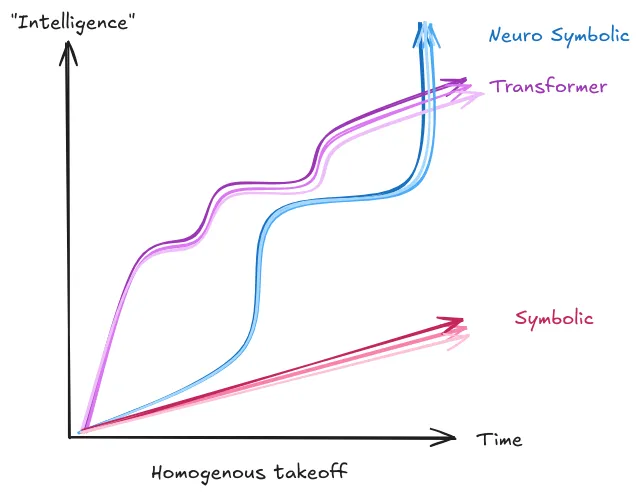
What is a heterogeneous takeoff? In a heterogeneous takeoff, we'd see significant diversity among advanced AI systems. Different organizations might develop fundamentally different approaches to AI, leading to systems with distinct strengths, weaknesses, and behaviors. Some might be specialized for specific domains while others are more general, some might be more transparent while others are more opaque, some might be more aligned with human values while others might not be. Competitive dynamics among AI projects could exacerbate diversity, as teams race to achieve breakthroughs without necessarily aligning on methodologies or sharing crucial information. As an example, we might have a future where AI becomes a strategic national asset, and AI development is closely guarded. In this environment, the pursuit of AI capabilities becomes siloed, each company or country would then employ different development methodologies, potentially leading to a wide range of behaviors, functionalities, and safety levels.
Heterogeneous takeoff creates different challenges for safety. We'd need to develop safety measures that work across diverse systems, and we couldn't necessarily apply lessons learned from one system to others. However, diversity might provide some protection against systemic risks - if one approach proves dangerous, alternatives would still exist.
How does takeoff homogeneity affect the broader picture? The degree of homogeneity during takeoff has significant implications for how transformative AI might develop. In a homogeneous scenario, progress might be more predictable but also more prone to winner-take-all dynamics. A heterogeneous scenario might be more robust against single points of failure but harder to monitor and control.

Polarity
What is takeoff polarity? Polarity describes whether power and capability becomes concentrated in a single AI system or organization, or remains distributed among multiple actors. In other words, will one AI system or group pull dramatically ahead of all others, or will multiple AI systems advance in parallel with comparable capabilities?
What is a unipolar takeoff? In a unipolar takeoff, one AI system or organization gains a decisive lead over all others. This could happen through a single breakthrough, exceptional scaling advantages, or recursive self-improvement. For example, if one AI system becomes capable enough to substantially accelerate its own development, it might rapidly outpace all other systems. The mathematics of training compute provide one path to a unipolar outcome. If a doubling of compute leads to reliable improvements in capability, then an organization that gets far enough ahead in acquiring compute could maintain or extend their lead. Their improved systems could then help them develop even better training methods, hardware, and attract investment creating a positive feedback loop that others can't match. But compute isn't the only path to unipolarity. A single organization might discover a fundamentally better training approach, or develop an AI system that's better at improving itself than at helping humans build alternatives. Once any actor gets far enough ahead, it might become practically impossible for others to catch up.
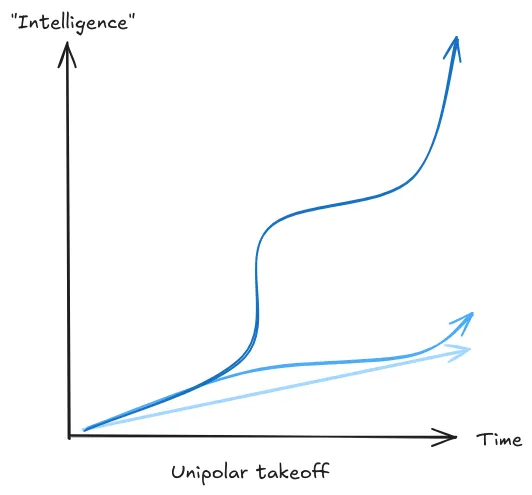
What is a multipolar takeoff? In a multipolar takeoff, multiple AI systems or organizations develop advanced capabilities in parallel. This could look like several large labs developing different but comparably powerful AI systems, or like many actors having access to similar AI capabilities through open source models or AI services. Today's AI landscape shows elements of multipolarity - multiple organizations can train large language models, and techniques developed by one lab are often quickly adopted by others. A multipolar takeoff might continue this pattern, with multiple groups maintaining similar capabilities even as those capabilities become transformative. A unipolar scenario raises concerns about the concentration of power, while a multipolar world presents challenges in coordination among diverse entities or AI systems. Both unipolar and multipolar worlds have the potential for misuse of advanced AI capabilities by human actors.

Why does polarity matter? The polarity of takeoff has major implications for both safety risks and potential solutions. In a unipolar scenario, the actions and alignment of a single system or organization become crucial - they might gain the ability to shape the long-term future unilaterally. This concentrates risk in a single point of failure, but might also make coordination easier since fewer actors need to agree. A multipolar scenario creates different challenges. Multiple advanced systems might act in conflicting ways or compete for resources. This could create pressure to deploy systems quickly or cut corners on safety. There's also an important interaction between polarity and the other aspects of takeoff we've discussed. A fast takeoff might be more likely to become unipolar, as the first system to make rapid progress could quickly outpace all others. A slow takeoff might tend toward multipolarity, giving more actors time to catch up to any initial leads.
Factors Influencing Polarity. Several key elements influence whether takeoff polarity leans towards a unipolar or multipolar outcome:
- Speed of AI Development: A rapid takeoff might favor a unipolar outcome by giving a significant advantage to the fastest developer. In contrast, a slower takeoff could lead to a multipolar world where many entities reach advanced capabilities more or less simultaneously.
- Collaboration vs. Competition: The degree of collaboration and openness in the AI research community can significantly affect takeoff polarity. High levels of collaboration and information sharing could support a multipolar outcome, while secretive or highly competitive environments might push towards unipolarity.
- Regulatory and Economic Dynamics: Regulatory frameworks and economic incentives also play a crucial role. Policies that encourage diversity in AI development and mitigate against the accumulation of too much power in any single entity's hands could foster a multipolar takeoff.